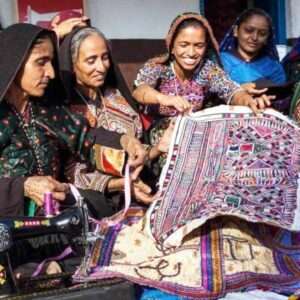
“I see Dastkar as both an organisation and a movement. The organisation started the movement and gave many NGOs and craftspeople the confidence to make good crafts products and market them directly. It showed us the way and gave us direction. Today, there is consequently an all India movement of craft as a means to sustainable employment. It is not necessary for Dastkar to grow as large as the movement or run the movement. At the same time without the organisation there would be no movement, and if there was no movement there would be little point in the organisation.”
Ela Bhatt , Founder, SEWA (Self Employed Women's Association)
“Dastkar is an organisation that recognises the genuine artisans and helps them reach urban markets. Dastkar is the “LIFE” of craftspeople.”
Vankar Harji Aatubhai, Gujarat
“Dastkar is an organisation that recognises the genuine artisans and helps them reach urban markets. Dastkar is the “LIFE” of craftspeople.”
Vankar Harji Aatubhai, Gujarat
“It will be a great loss for institutions like us if NATURE BAZAAR does not happen. We are supporting the lives of more than 300 Lambani tribal women families”
Veeranna, Sandur Kushala Kala Kendra, Karnataka
“Over the years a large number of craftgroups have been able to get a foothold in the Delhi market for handicrafts. Dastkar has helped a lot and provided tremendous services in this regard.”
Joe Madiath, Gram Vikas, Odisha
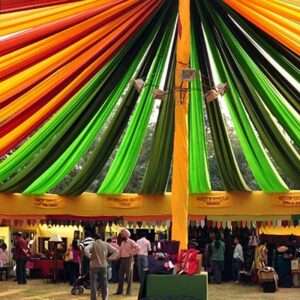
“Love the old world vibe, so ethnic and aesthetic. Thank God we don’t have to do this in a mall.”
“We love to come to Dastkar for all the exhibitions because everything is so exclusive here. The artisans are so polite and we totally love to sit and eat here.”
“Great collection as usual. Always compelling me to buy more and more.”